
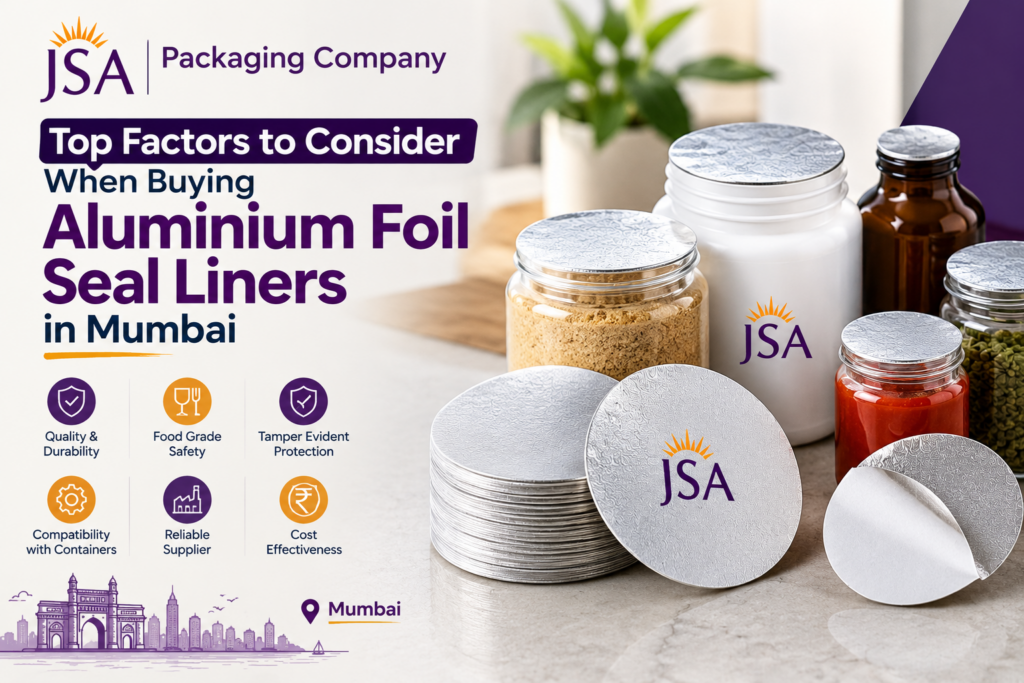
Packaging is often the first line of protection between a product and the outside environment. While bottles, jars, and caps get most of the attention, the sealing liner inside the cap plays an equally important role in maintaining package integrity.
For manufacturers, choosing the right aluminium foil seal liners in Mumbai is not simply a matter of comparing prices. The liner needs to work properly with the container, cap, product, and sealing equipment. A small mismatch can lead to poor sealing, leakage, contamination, production interruptions, or unnecessary packaging waste.
This is particularly important for businesses operating in industries such as FMCG, pharmaceuticals, food processing, edible oils, cosmetics, and chemicals, where packaging performance can directly affect product protection and customer experience.
At JSA Packaging Company, we manufacture high-quality induction sealing wads, liners, and packaging sealing solutions designed to help protect products from leakage, contamination, and tampering.
So, what should you actually look for before purchasing aluminium foil seal liners?
Let’s look at the key factors that can help you make a more informed decision.
Understanding Aluminium Foil Seal Liners
An aluminium foil seal liner is placed inside a bottle or jar cap and is designed to create a secure seal over the container opening.
In induction sealing applications, the liner works with an induction sealing machine to create a seal between the liner and the container. Depending on the packaging requirement, liners can have different material combinations and constructions.
The important point is that there isn’t one universal liner suitable for every packaging application.
A liner suitable for a PET bottle may not necessarily be the right choice for an HDPE jar. Similarly, the requirements of a pharmaceutical container can differ from those of an edible oil or cosmetic product.
This is why understanding your packaging requirements before buying is essential.
1. Start With Your Container Material
The first thing to identify is the material of your bottle or jar.
Common packaging materials include:
- HDPE
- PET
- PP
- Glass
- Other compatible container materials
The sealing surface of each container can behave differently during the sealing process. Therefore, the liner should be selected according to the container material and actual application.
For example, manufacturers using HDPE packaging may specifically require induction wads for HDPE jars rather than selecting a liner simply because it is available at a lower price.
Before placing an order, share the container material and, ideally, a sample or accurate specifications with your supplier.
2. Get the Correct Size
Size is one of the simplest things to check, but it is also one of the areas where mistakes can happen.
The liner needs to fit appropriately inside the cap and cover the required sealing area of the container.
Before ordering, confirm:
- Cap diameter
- Container neck diameter
- Inner cap dimensions
- Required liner diameter
- Sealing area
- Available space inside the cap
If the liner is incorrectly sized, the sealing process may become inconsistent.
For businesses purchasing aluminium foil seal liners in Mumbai in large quantities, checking dimensions before bulk production can save considerable time and material costs later.
3. Consider the Product You Are Packaging
The product inside the container matters just as much as the container itself.
A manufacturer packaging spices, for example, may have different requirements from a company packaging edible oil. Pharmaceutical products, cosmetics, chemicals, and food products can all have their own packaging considerations.
Ask yourself:
- Is the product liquid or solid?
- Is it oily?
- Is it moisture-sensitive?
- Does it require strong protection from external contamination?
- Will it be exposed to different temperatures during transportation?
- Does the package need tamper evidence?
The answers can help determine which liner construction is appropriate.
A supplier with experience across different industries can also help you identify practical options rather than simply supplying a standard product.
4. Check Compatibility With Your Cap
The cap and liner work together, so both should be considered when selecting a sealing solution.
Different cap designs, materials, and dimensions can influence how the liner sits inside the closure and how the sealing process performs.
Before finalising your purchase, provide your supplier with information about:
- Cap material
- Cap size
- Cap design
- Container neck finish
- Liner requirements
This becomes particularly important when changing suppliers. A liner that worked with one cap specification should not automatically be assumed to work with another.
5. Make Sure It Works With Your Sealing Machine
A good liner still needs to work correctly with your induction sealing equipment.
Induction sealing uses electromagnetic energy to heat the appropriate sealing layer, allowing the liner to bond with the container surface.
Your sealing machine, container, cap, and liner therefore need to work as a complete system.
Before buying, discuss:
- Machine type
- Sealing speed
- Container dimensions
- Cap specifications
- Production volume
- Current sealing settings
If you are introducing a new liner into an existing production line, conducting a trial run before placing a large order is a sensible step.
6. Don’t Make Price the Only Deciding Factor
Price naturally matters when purchasing packaging materials, particularly for high-volume manufacturers.
However, choosing a supplier purely because they offer the lowest price can create problems later.
Consider the total cost of the packaging solution.
For example, inconsistent liners may lead to:
- Failed seals
- Product leakage
- Rejected packaging
- Production downtime
- Material wastage
- Rework
- Customer complaints
A slightly different purchase price can become insignificant if the product performs consistently and reduces operational issues.
For businesses looking for wholesale induction cap liners, the better approach is to compare quality, consistency, supply capability, and pricing together.
7. Check Batch-to-Batch Consistency
A sample may perform well, but what happens when you receive your third, fourth, or fifth batch?
This is an important question for regular packaging buyers.
Industrial packaging requires consistency. If the sealing performance changes significantly between batches, your production team may have to adjust machine settings repeatedly.
When evaluating a supplier, ask about:
- Material consistency
- Dimensional accuracy
- Sealing performance
- Quality checks
- Production controls
- Batch consistency
A dependable manufacturer should understand that long-term buyers need predictable results rather than just a good first sample.
8. Ask for Samples Before a Large Order
If you have never purchased from a supplier before, testing samples is one of the most practical steps you can take.
Use the sample with your actual:
- Bottle or jar
- Cap
- Product
- Induction sealing machine
Then check the finished seal.
Look for issues such as:
- Incomplete sealing
- Wrinkling
- Poor adhesion
- Uneven sealing
- Difficulty opening
- Damage to the liner
- Leakage
Testing under real production conditions provides much more useful information than simply looking at the liner itself.
9. Think About Your Production Volume
Your purchasing requirements will depend heavily on how much packaging you use.
A small manufacturer may need relatively limited quantities, while a large FMCG or pharmaceutical company may require regular bulk supplies.
Before choosing your supplier, consider:
- Monthly consumption
- Minimum order quantity
- Lead time
- Stock availability
- Delivery schedule
- Future growth
If your business is expanding, it makes sense to work with a manufacturer capable of supporting your increasing requirements.
Reliable supply can be just as important as product quality when packaging materials are part of a continuous production process.
10. Consider Custom Requirements
Standard liners may work perfectly for many applications, but some packaging projects have specific requirements.
Depending on the application, you may need particular:
- Dimensions
- Material combinations
- Liner construction
- Sealing characteristics
- Packaging quantities
- Product compatibility
If your container or packaging line has unusual specifications, discuss them with your manufacturer before ordering.
Instead of trying to adapt a standard product to your application, it may be more practical to identify a liner designed around your actual requirements.
11. Pay Attention to Storage
Once the liners arrive, proper storage also matters.
Packaging materials should be stored in appropriate conditions and protected from excessive moisture, heat, contamination, and direct sunlight.
This becomes especially important when purchasing in bulk and keeping inventory for several weeks or months.
Ask your supplier about recommended storage and handling practices so that the material remains in suitable condition until it reaches the production line.
Aluminium Foil Seal Liners for Different Industries
The right sealing solution can vary considerably depending on the industry.
FMCG
FMCG products often move through long distribution chains before reaching the customer. Secure packaging can help protect the product during handling, transportation, and storage.
Pharmaceuticals
Pharmaceutical packaging requires careful attention to packaging integrity and product protection. The sealing solution should be selected according to the specific container and application.
Food Processing
Food manufacturers need packaging that helps protect products from external contamination and supports product quality throughout storage and distribution.
Edible Oils
Leak prevention is particularly important for liquid products. The liner and container combination should be evaluated for the actual packaging application.
Cosmetics
Cosmetic products such as creams, powders, gels, and other formulations can have different sealing requirements depending on their packaging format.
Chemicals
Chemical products may require additional consideration when selecting packaging materials. Product compatibility and sealing performance should be evaluated before production.
Why Supplier Selection Matters in Mumbai
Mumbai has a large and diverse manufacturing and packaging ecosystem. This gives buyers access to numerous packaging suppliers, but it can also make the selection process more complicated.
A good supplier should not simply ask how many pieces you need.
They should understand your application.
When comparing aluminium foil seal liners in Mumbai, look beyond the quotation and consider:
Product suitability + quality consistency + technical support + supply reliability + overall cost
This approach helps you identify a supplier that can support your packaging requirements over the long term.
Why Choose JSA Packaging Company?
At JSA Packaging Company, our focus is on providing practical packaging sealing solutions for businesses across different industries.
We manufacture high-quality induction sealing wads and liners used in applications involving FMCG, pharmaceuticals, edible oils, cosmetics, chemicals, and food processing.
Whether you are evaluating aluminium foil seal liners in Mumbai, looking for induction sealing wads, or sourcing liners for HDPE packaging, understanding your exact application is the starting point.
For businesses purchasing packaging materials regularly, we also understand the importance of consistent quality and dependable supply.
Our goal is to provide sealing solutions that fit real packaging requirements rather than treating every application in the same way.
To learn more about our products and packaging solutions, visit the JSA Packaging Company website and discuss your requirements with our team.
Frequently Asked Questions
- What are aluminium foil seal liners used for?
Aluminium foil seal liners are used inside bottle and jar caps to create a protective seal over the container opening. They can help reduce leakage and protect the packaged product from external contamination and tampering.
- How do I choose the right liner for my bottle?
Start by identifying the container material, cap size, neck dimensions, product type, and sealing equipment. Testing the liner with your actual packaging setup is recommended before placing a large order.
- Can aluminium foil liners be used with HDPE jars?
Yes, suitable induction sealing solutions are available for HDPE jars. However, the liner should be selected according to the specific HDPE container, cap, and sealing process.
- What are induction sealing wads?
Induction sealing wads are sealing liners designed to work with induction sealing equipment. Their construction can vary depending on the container, product, and application.
- Should I buy wholesale induction cap liners?
Wholesale purchasing can make sense for manufacturers with regular or high-volume packaging requirements. Before buying in bulk, confirm product specifications, quality consistency, minimum order quantity, and delivery capability.
Final Words
The right sealing liner is a small part of the overall package, but its role should not be underestimated.
When purchasing aluminium foil seal liners in Mumbai, consider more than just the price. Container compatibility, liner dimensions, product characteristics, cap specifications, sealing equipment, quality consistency, supply capability, and sample testing all contribute to a successful packaging solution.
Taking the time to evaluate these factors can help manufacturers avoid unnecessary sealing problems and make their packaging process more reliable.
If you are looking for dependable induction sealing wads, liners, or other packaging sealing solutions, JSA Packaging Company can help you identify an option suited to your application.
JSA Packaging Company is the best option for you.